There’s a moment that comes up constantly in this business. A contractor finds a five-year-old excavator with 3,200 hours at about 60% of what a new one costs. It’s the right machine. The seller wants an answer this week. And the contractor’s bank has told him used equipment isn’t really their thing.
That deal is financeable. We fund versions of it every month.
The idea that used equipment is hard to finance is one of the most persistent myths in the market, and it costs growing companies real money — either in equipment they don’t buy or in cash they hand over that should have stayed in the business. Here’s how used equipment financing actually works, what we look at, and how to put yourself in the best position before you ask.
Key takeaways
- Used equipment is financeable. We fund it routinely, including auction and private-party purchases.
- Condition and hours matter more than model year. A well-maintained ten-year-old machine can underwrite better than a neglected five-year-old one.
- Application-only up to $400,000 means most used equipment purchases never require financial statements — which matters when a seller wants an answer in 48 hours.
- Used equipment qualifies for Section 179 the same as new, as long as it’s new to your business and placed in service before year-end.
- A bank decline on used equipment usually reflects that bank’s policy, not the quality of the deal.
What used equipment financing actually is
It’s financing for pre-owned machinery, vehicles, and business assets — structured so you pay over time while the equipment earns.
Mechanically it works the same as new equipment financing. You identify the machine, we underwrite the transaction, we pay the seller, and you make payments to us. The difference is in the evaluation: with used equipment we’re paying closer attention to what the asset is worth today and what it’ll be worth in three years, because that’s our collateral.
The structure can be an equipment finance agreement where you own the machine outright at payoff, or a lease with purchase, renewal, or return options at term end. Which one fits depends on how long you plan to keep it.
Why growing companies buy used
The obvious reason is price. But the more interesting reason is what the price difference lets you do.
A new machine at $280,000 versus a comparable used one at $165,000 isn’t just a $115,000 savings. It’s $115,000 that’s available for a second machine, a hire, a slow quarter, or a bid you couldn’t otherwise cover. For a company in a growth phase, that flexibility is frequently worth more than the warranty and the fresh paint.
Equipment depreciation also does most of its damage early. Heavy construction equipment, commercial trucks, and industrial machine tools are built to run for decades. A machine that’s absorbed the steepest part of the depreciation curve and still has 70% of its useful life left is, in pure economic terms, a better buy than a new one — as long as it’s been maintained.
The one question that actually matters: does this machine have enough life left to outlast the financing term with room to spare? If yes, used usually wins. If it’s close, the math gets thinner.
What we look at on a used equipment deal
Condition and hours, not just year
Model year is the number everybody fixates on and it’s the least useful one on its own. A 2016 excavator with 2,800 hours, documented service intervals, and a recent undercarriage replacement is a stronger asset than a 2021 with 9,000 hard hours and no records.
We’d rather see hours, maintenance history, and photos than a spec sheet. If you have service records, send them. They move deals.
What the asset is worth, and what it stays worth
We’re looking at current market value and how the category holds value. Equipment with deep, liquid secondary markets — construction machinery, class 8 trucks, machine tools, trailers — is easier to finance because there’s a real number behind it and a real market if something goes wrong.
Highly specialized equipment with a thin resale market takes more work. Not a no, but it usually means more evaluation, sometimes a shorter term, and occasionally a down payment.
Where you’re buying it
Dealer purchases move fastest. Dealers supply condition reports, clear title, sometimes warranty coverage, and a bill of sale that doesn’t raise questions.
Auction purchases are absolutely financeable, and this is where the $400,000 application-only threshold earns its keep. Auctions run on short clocks. If you need to know whether you can bid, you need an answer in a day, not in three weeks after somebody assembles a financial package. Under $400,000, we work off a one-page application — no tax returns, no financial statements.
Private-party purchases work too. They just take a little more documentation: verifying ownership, confirming there’s no existing lien, establishing condition. Tell us up front that it’s private-party and we’ll tell you exactly what we need.
Your business, and what the machine will do
We underwrite the borrower and the equipment together. Time in business, revenue, and credit all matter — but so does what the machine is going to earn. A company with three years of history and a signed contract that requires this specific equipment is a very different credit than the same company buying speculatively.
That’s the practical difference between an independent and a bank. A bank runs your financials against a credit box. We look at the financials, the asset, the industry, and the job the equipment is going to do. It’s a wider aperture, and it’s why used equipment deals that stall at a bank often clear here.
Where used equipment financing works best
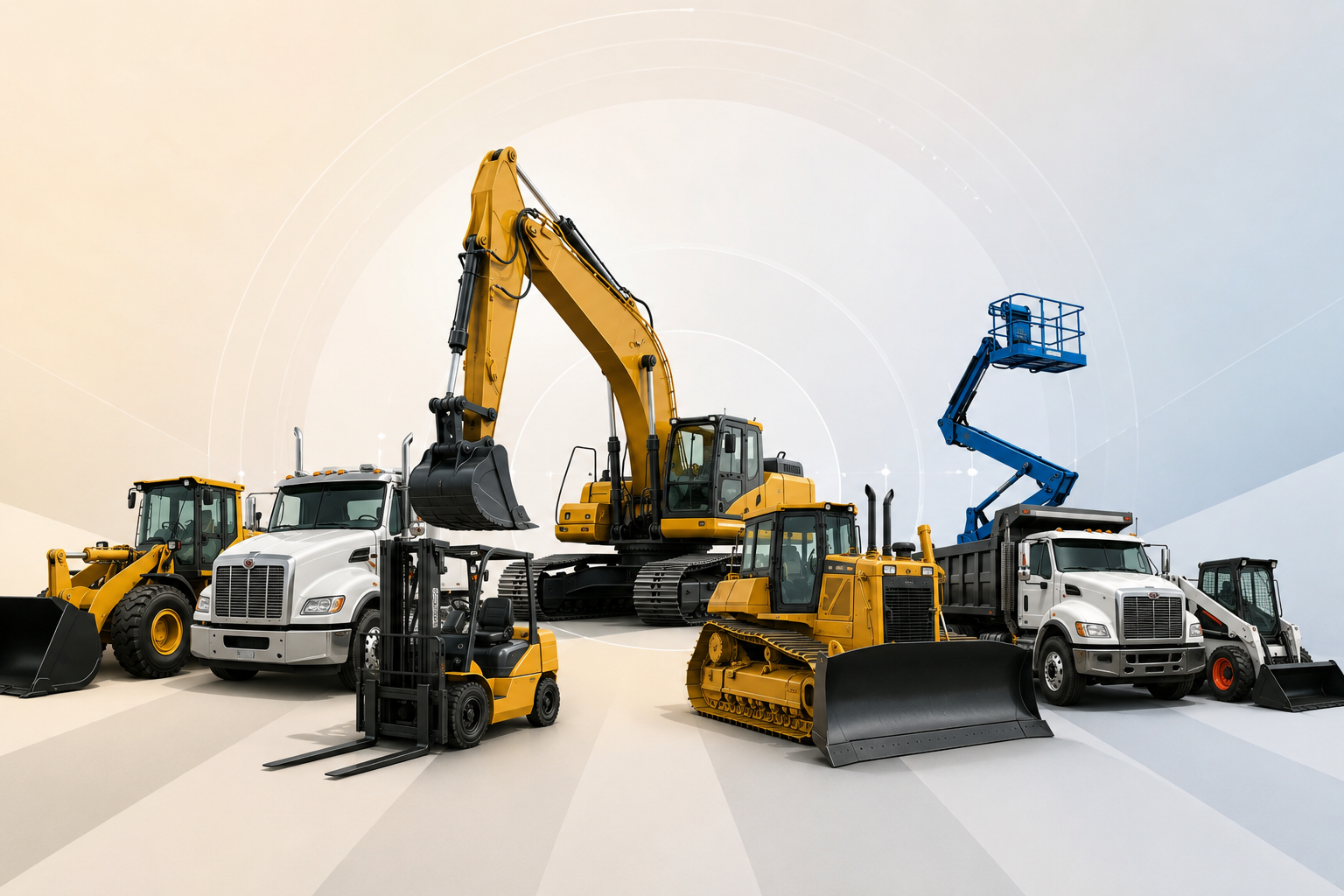
Construction. Excavators, loaders, dozers, cranes, attachments, and support vehicles. Heavy equipment is built for long service lives and has one of the deepest resale markets in the country. Used is the norm here, not the exception.
Transportation. Tractors, trailers, box trucks, and vocational vehicles. A well-spec’d used truck delivers the same revenue per mile as a new one, and the capital you keep covers fuel, insurance, and driver pay while the unit gets rolling.
Manufacturing. CNC machines, presses, and production lines routinely run for decades. Machine tools in particular hold value exceptionally well, which makes them straightforward to underwrite.
Medical and dental. Imaging systems, chairs, lasers, and practice technology. Buying pre-owned lets a practice add a capability at a fraction of the cost, though technology-dependent equipment ages faster than steel — worth weighing term length against how quickly the category turns over.
We work across a broader set of industries than these four — waste and recycling, tree care, marine, aviation, logistics, and specialty equipment among them.
Section 179 on used equipment
This is the piece most buyers don’t know, and it’s worth real money.
Used equipment generally qualifies for the Section 179 deduction the same way new equipment does. The requirement is that it’s new to your business and placed in service before year-end — not that it’s new off the line.
Combine that with financing and the arithmetic gets interesting: you can potentially deduct the equipment cost this year while spreading payments across the next several. A used machine bought in Q4 can produce a deduction that substantially offsets the first year of payments.
The constraint is timing. It has to be in service before December 31, which means a deal started on December 22 has a much narrower path than one started in October. Confirm your specifics with your CPA — but if you’re considering a used purchase and it’s already fall, start the conversation early.
The concerns we hear most
“Banks won’t finance used equipment.”
Some won’t, or will only above a certain condition threshold. That’s a policy decision at that institution, not a judgment about your deal. Independent finance companies underwrite the asset alongside the credit, which is a different question with a frequently different answer. If you’ve already been told no, that’s not necessarily the end of it.
“Used equipment is too risky to finance.”
Risk lives in the specific machine, not in the category. Documented maintenance, reasonable hours, and a real secondary market make a used asset perfectly ordinary to underwrite. An undocumented machine of unknown history is a harder conversation — which is also true when you’re the one buying it.
“The terms will be bad.”
Terms track the asset. Quality used equipment from a credible source in a category with a strong resale market gets competitive treatment. Where terms tighten is on older assets, thin secondary markets, or short remaining useful life — and in those cases the structure usually adjusts before the rate does, often through a shorter term or a down payment.
“I’ll need a big down payment.”
Not usually. 100% financing is available on many used transactions. A down payment can improve terms and sometimes makes a marginal deal work, but it isn’t a default requirement. If cash preservation is the whole point of the purchase, say so and we’ll structure around it.
How to put yourself in the best position
Three things speed a used equipment deal up more than anything else.
Have the equipment details ready. Make, model, year, serial number, hours or mileage, and photos. Service records if you have them. This is the single biggest difference between a same-day answer and a week of back-and-forth.
Know your timeline and say it out loud. An auction closing Thursday is a different conversation than a purchase you’re contemplating for next quarter. If there’s a clock, tell us at the start — it changes how we sequence the file.
Be able to explain what the machine does for the business. Not a formal projection. Just the practical version: what work it enables, what it replaces, what it bills. That context genuinely affects how a transaction gets evaluated, and it’s the part of a deal that a credit score can’t tell us.
Where we land on this
We finance used equipment as a matter of course, not as an exception. We’ve been doing it since 1987, on transactions from $3,000 to over $5,000,000, across most of the industries where used equipment is how the work actually gets done.
We’re not always the cheapest money available. If you have long, clean financials and eight weeks to spare, your bank may beat us on rate, and we’d tell you that directly. What we’re built for is the deal with a clock on it, the machine a generalist lender doesn’t understand, and the company whose financials haven’t caught up to where the business actually is.
If you’re looking at a used machine and want to know where you stand, send us the details. Most of the time we can tell you the same day. Get in touch or call 877.790.0049.
FAQs
Can I finance used equipment?
Yes. We finance new and used equipment across construction, transportation, manufacturing, medical, waste, tree care, and specialty categories. Used transactions are a routine part of what we do, not a special case.
What kinds of used equipment can be financed?
Construction machinery, commercial trucks and trailers, machine tools and production equipment, medical and imaging systems, and a wide range of specialty assets. Condition, remaining useful life, and resale market depth matter more than the category itself.
Is there an age or hours cutoff?
We don’t apply a flat age cutoff. We evaluate condition, hours, maintenance history, and remaining useful life against the term you’re asking for. Older equipment sometimes means a shorter term rather than a decline.
Can I finance equipment bought at auction or from a private party?
Yes to both. Auction purchases are common and the $400,000 application-only threshold is designed for exactly that kind of timeline. Private-party deals need some extra documentation — ownership verification and lien confirmation — but they get done regularly.
How is used equipment financing different from new?
The underwriting includes a closer look at the specific asset: condition, hours, market value, and remaining life. Terms may be shorter on older equipment to stay within its useful life. Otherwise the process, the paperwork, and the timeline look the same.
Does used equipment qualify for Section 179?
Generally yes, provided it’s new to your business and placed in service before year-end. Used equipment doesn’t have to be new off the line to qualify. Confirm the specifics with your CPA.
How fast can I get an answer?
For qualified application-only transactions, funding in as little as 24 hours. Having equipment details and photos ready at the outset is the biggest factor in hitting that timeline.
Is there a minimum or maximum?
We finance from $3,000 to over $5,000,000. Small single-unit purchases and large capital investments both fit.
Do I need a down payment?
Often not — 100% financing is available on many used transactions. A down payment can improve terms or help a marginal deal clear, but it’s a structuring tool rather than a requirement.
My bank declined a used equipment request. Now what?
Come talk to us. A decline usually means the request fell outside that bank’s parameters, not that the deal is unfinanceable. We underwrite the equipment alongside the credit, and used equipment declines are one of the more common reasons companies find their way to us. Preserving working capital while still getting the machine is usually the goal, and there’s more than one way to get there.